
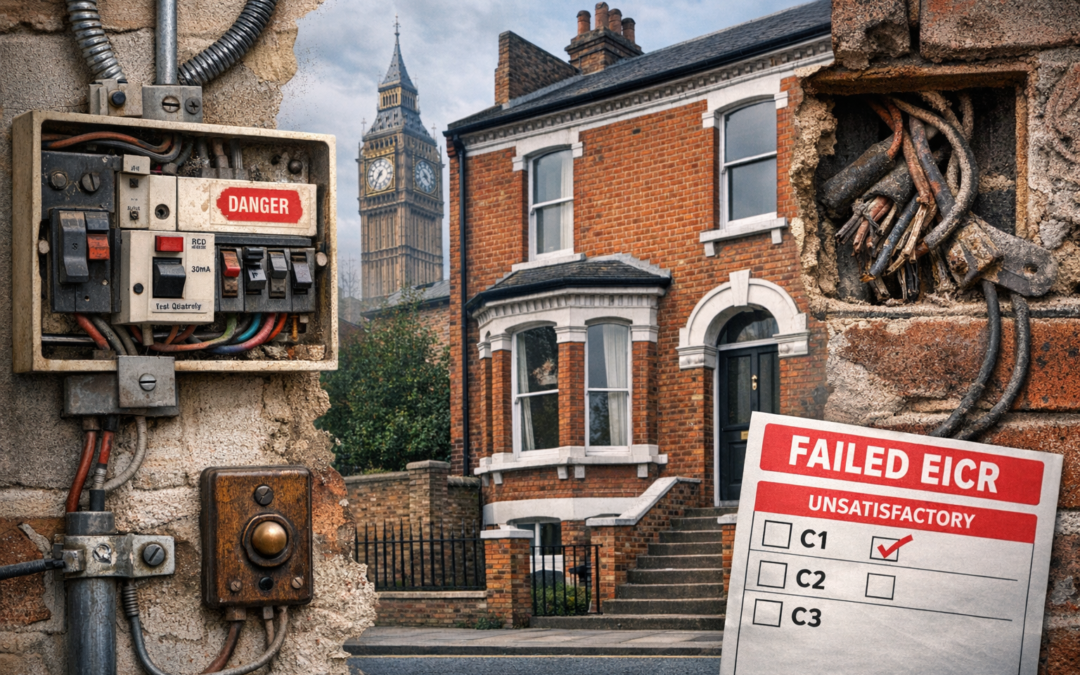
Victorian & Edwardian Home Safety: Why 100-Year-Old London Homes Often Fail EICRs (and What Landlords Miss)
If you own or manage a Victorian or Edwardian property in London, EICRs can feel unpredictable. One inspection passes, the next comes back “Unsatisfactory” — even though nothing obvious has changed.
This usually isn’t bad luck. It’s down to how these homes were built, altered, and adapted over decades.
Period properties make up a big chunk of London’s housing stock, but they also account for a disproportionate number of failed Electrical Installation Condition Reports. The reasons are specific, repeatable, and often misunderstood by landlords.
Why Period Properties Are a London-Specific EICR Problem
Victorian and Edwardian homes weren’t designed for modern electrical demand. Most were built long before ring circuits, modern earthing standards, RCD protection, and today’s high-load appliances.
What makes it worse in London is how often these homes have been altered. Loft conversions, basement extensions, buy-to-let conversions, and repeated refurbishments are common — often carried out years apart, by different contractors, under different rules.
The result? Layered electrical systems that still “work”, but don’t meet modern safety expectations.
The Most Common EICR Failures in Victorian & Edwardian Homes
1) Inadequate or outdated earthing and bonding
One of the most common causes of an Unsatisfactory outcome is earthing and bonding that’s incomplete or not up to current standards.
- Earthing that was added later, rather than designed in
- Missing or inadequate bonding to gas and water services
- Older metal pipework increasing risk if bonding is poor
Landlords are often surprised by this — especially when everything “seems fine” day to day.
2) Consumer units with partial protection
Another big one is the fuse board (consumer unit). Typical findings in period homes include:
- Older boards with limited RCD protection
- No 30mA RCD protection on socket circuits where required
- One RCD covering too many circuits (nuisance tripping + reduced resilience)
In London terraces, it’s common to see new circuits added over time without the protective devices being properly modernised.
3) Mixed-age wiring hidden behind finishes
This is the bit landlords rarely anticipate: mixed wiring ages across the same property.
- Older rubber-insulated cabling still in service in places
- Early PVC mixed with newer runs
- Junctions buried under floors or behind plaster from historic alterations
Even if the property was “rewired”, it’s not unusual for older sections to remain. Some materials degrade with age and can lead to higher-risk classifications.
4) Lighting circuits that don’t meet modern expectations
Lighting is a quiet failure point in Victorian/Edwardian homes, especially where fittings have been upgraded but wiring hasn’t.
- No earth present on older lighting circuits
- Metal fittings added without upgrading cable/earthing
- Non-fire-rated downlights installed in loft conversions
What Landlords Commonly Miss (Until It’s Too Late)
“It passed before, so it should pass again.”
This is a risky assumption. A previous pass doesn’t guarantee future compliance if the property has changed, usage has increased, or the inspection reveals issues that weren’t identified (or weren’t present) last time.
Assuming “old” automatically means “unsafe”
Here’s the reality: not everything old needs ripping out.
Some period properties fail EICRs not because they’re immediately dangerous, but because protective measures haven’t been modernised. In many cases, targeted upgrades (rather than full rewires) are enough to reach a Satisfactory outcome.
A Realistic London Example
Scenario: A two-bedroom Victorian terrace in South London converted into two flats.
- Original structure
- Rewired in the 1990s
- Later kitchen upgrade
- Older split-load consumer unit
Result: The EICR comes back Unsatisfactory due to:
- Protection not meeting current expectations for parts of the installation
- Bonding requiring improvement
- Too many circuits relying on a single RCD (reliability issue)
Key point: This type of outcome often needs a focused upgrade (for example, improved protection and bonding), not a full rewire. That distinction can save landlords thousands — especially when managing multiple properties.
HMOs and Period Properties: Where Problems Multiply
Victorian and Edwardian homes are often converted into HMOs. That’s where EICRs tend to be tougher, because the risk profile changes.
- Higher occupancy
- Greater electrical load
- Higher fire risk and more reliance on lighting and socket circuits
Inspectors will pay closer attention to protection, circuit resilience, and whether alterations were done properly. In an HMO, issues that might be tolerated as lower priority in a single-let can become more serious.
How Landlords Can Reduce EICR Failures in Period Homes
- Don’t leave it until renewal — consider a pre-check for older properties
- Budget for protective upgrades, not just the inspection fee
- Treat the consumer unit as safety equipment, not “optional”
- Use an electrician familiar with London period stock (terraces, conversions, mixed wiring)
And don’t be afraid to ask: why is something coded this way? What’s the actual risk? What’s the most sensible fix?
Final Thought: Period Homes Aren’t the Problem — Assumptions Are
Victorian and Edwardian properties aren’t unsafe by default. They’re just different.
Most EICR failures in London period homes come down to incremental changes, partial upgrades, and modern usage layered onto historic design. If you understand where they typically fail, you can plan properly — and avoid last-minute panic and unnecessary expense.
Call to Action
If you’re a London landlord with a Victorian or Edwardian property and your EICR is due, it’s worth getting ahead of the usual problem areas. If you’d like an inspection booked (or a quick pre-check approach), get in touch and we’ll talk you through the sensible options.