
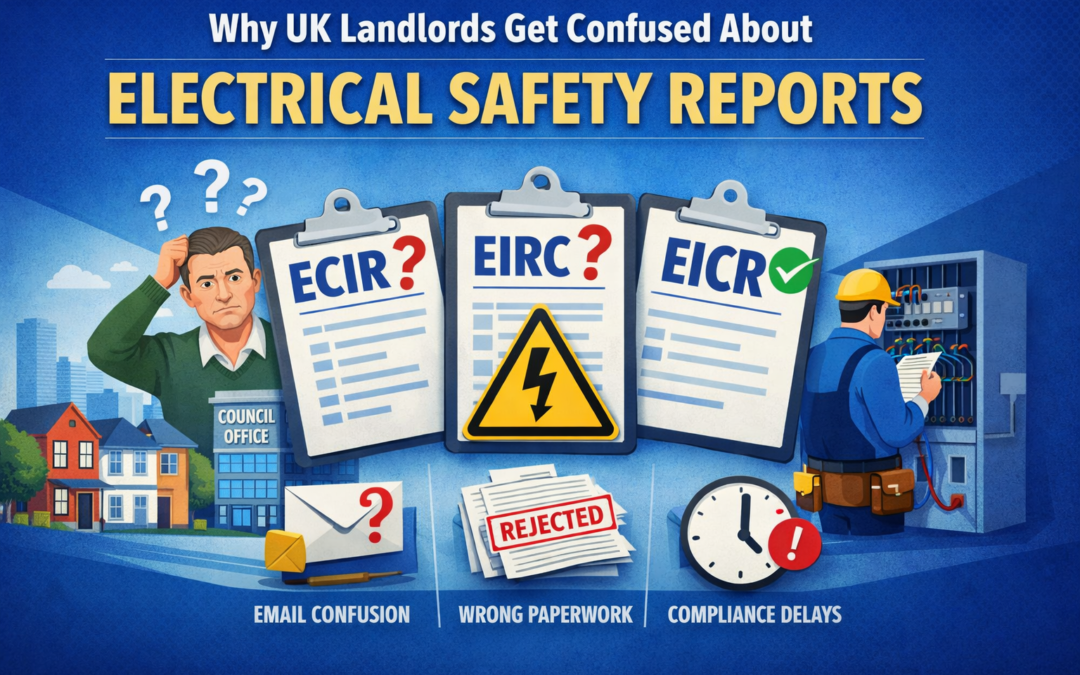
If you’re a landlord, letting agent, or property manager, you may have seen the terms ECIR, EIRC, and EICR used interchangeably. They often appear in emails, maintenance logs, and compliance requests — but only one of these terms is actually correct.
This confusion regularly causes delays, rejected paperwork, and unnecessary back-and-forth between landlords, agents, electricians, and local authorities. This guide explains the difference clearly and sets out what landlords are legally required to provide.
What Does EICR Stand For?
EICR stands for Electrical Installation Condition Report.
An EICR is a formal inspection and testing report that assesses the safety and condition of a property’s fixed electrical installation. It checks whether the electrics are safe for continued use and identifies any issues that need to be addressed.
In England, landlords are legally required to hold a valid EICR for most rented properties and provide it:
-
To tenants
-
To letting agents
-
To local authorities if requested
The report must be carried out by a qualified and competent electrician and is typically valid for five years, unless the report states otherwise.
What Are ECIR and EIRC?
ECIR and EIRC are not recognised documents.
There is no inspection, certificate, or legal report called an ECIR or an EIRC. Both terms are simply incorrect letter arrangements of EICR and have no official meaning in electrical regulations or legislation.
Despite this, they are commonly used:
-
In emails from landlords or managing agents
-
On compliance portals or spreadsheets
-
In council correspondence
-
During phone calls and informal requests
This is where confusion and delays often begin.
Why Do People Get ECIR, EIRC, and EICR Confused?
The mix-up usually comes down to habit and informal communication rather than regulation.
Common reasons include:
-
Remembering the acronym incorrectly
-
Assuming ECIR or EIRC is an accepted alternative
-
Copying wording from older emails or templates
-
Non-technical staff using terms interchangeably
Once an incorrect term is introduced, it often gets repeated across systems and documents.
Does Using ECIR or EIRC Actually Matter?
In casual conversation, electricians usually understand what is meant. However, in formal or legal contexts, it does matter.
Local authorities, housing teams, and compliance departments expect a valid EICR. When documents are referred to as an ECIR or EIRC, this can lead to:
-
Requests being rejected
-
Clarification emails being sent
-
Delays in confirming compliance
-
Confusion over whether the correct document has been supplied
In some cases, landlords are asked to resubmit documents even though the inspection itself was carried out correctly.
What Are Landlords Legally Required to Provide?
For most rented properties in England, landlords must provide:
-
A current Electrical Installation Condition Report (EICR)
-
Issued by a qualified electrician
-
Showing a satisfactory outcome, or confirmation that remedial works have been completed
There is no requirement for an ECIR or EIRC, and providing paperwork labelled incorrectly can create unnecessary problems.
Common Mistakes Landlords and Agents Make
Some of the most frequent issues seen in practice include:
-
Asking electricians for an “ECIR” or “EIRC” instead of an EICR
-
Uploading documents with incorrect labels to portals
-
Assuming any electrical certificate is sufficient
-
Confusing EICRs with installation certificates
These errors are usually administrative but can still delay compliance.
What Should You Ask Your Electrician For?
To avoid confusion, landlords and agents should always request:
-
An Electrical Installation Condition Report (EICR)
-
Clearly labelled as an EICR
-
Showing the inspection date and recommended re-inspection period
If someone refers to an ECIR or EIRC, it is reasonable to clarify that they mean an EICR before proceeding.
The Bottom Line
There is no such thing as an ECIR or an EIRC.
The correct and legally recognised document is the EICR.
Understanding the difference helps landlords avoid delays, ensures compliance paperwork is accepted first time, and removes unnecessary confusion during inspections and renewals.